

![]() |
![]() |
![]() |

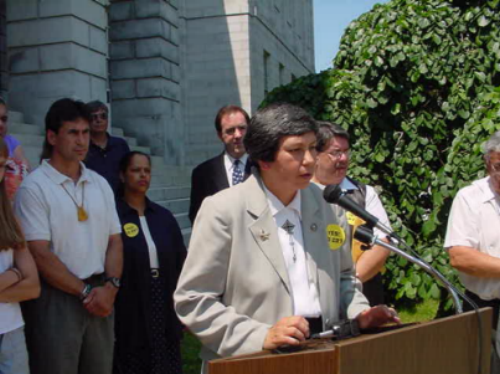
Donna was the sponsor of the Maine State Education Act, which requires teaching the History of Maine's First Nations, including the genocide committed against them by European colonials and their descendents. A copy follows her bio:
Donna is a tribal member of the Penobscot Indian Nation. She has been the Nation’s Representative to the Maine State Legislature since October of 1997 and, serves as the Nation’s Coordinator of Tribal, State, and International Relations.
She is a graduate of the University of Maine at Orono - Bachelor of Arts in Political Science - and is a graduate of the Maine Criminal Justice Academy. Donna has considerable experience in law enforcement. She served as Police Chief for the Penobscot Nation from 1984-1990, which gave her the disttinction of being the first female police academy graduate in the State of Maine to become police chief . From 1992 to March of 1997, she was director of security at Bowdoin College, the first female to hold the position, and was a member of the Maine Chiefs of Police for eleven years.
Loring is a Vietnam War Veteran. During her stint, November 1967 to November 1968, she served in the communications center at Long Binh Army Base, located approximately thirty miles northeast of Siagon. Her job was to process all casualty reports for Southeast Asia.
Donna was appointed Aide de Camp to former Governor Angus King on March 17, 1999 and was commissioned with the rank of Colonel by the Governor. She was advisor to the former Governor on women veteran affairs.
To hone her leadeship skills she has taken several upgrading courses. She is a recent graduate of the Flemming Fellows Leadership Institute Class of 2001. The Program is a value based leadership program under the auspices of the Center for Policy Alternatives, which is a nationally respected and recognized organization of progressive, innovative and creative political leaders.
Recently she graduated from the Eleanor Roosevelt Global Leadership Institute. It is a unique leadership program that provides training to help state legislators address the impact of globalization at both the state and local level. She was one of 14 state legislators, selected from among more than 7,000 eligible state legislators from across the nation. They were sent to Chile to learn about the Chilean development process in the areas of economic development, social development, and foreign trade. They attended meetings with various local and regional government leaders and with American Embassy officials.
The former Speaker of the House, Michael Saxl, appointed Donna, August 2002, House Chair of the Casino Study Task Force, which gave her another first, she was the first Tribal representative to be appointed as a House Chair of a committee.
For her dedication to duty, on November 4,1999, Donna received the Mary Ann Hartman Award from the University of Maine’s Women in Curriculum and Women’s Studies Program. The award recognizes Maine women for outstanding accomplishments in the arts, politics, business, education and community services.
In addition to her political duties Donna serves on the following Boards and committees:
Commission on Women Veterans (created by the 118th Legislature) CHAPTER 403, H.P. 255 - L.D. 291
An Act to Require Teaching of Maine Native American History and Culture in Maine's Schools
Be it enacted by the People of the State of Maine as follows:
Sec. 1. 20-A MRSA §4706, as amended by PL 1991, c. 655, §4, is further amended to read:
§4706. Instruction in American history, Maine studies and Maine Native American history
The following subjects shall be are required.
1. American history. American history and civil government, including the Constitution of the United States, the Declaration of Independence, the importance of voting and the privileges and responsibilities of citizenship, shall must be taught in and required for graduation from all elementary and secondary schools, both public and private.
2. Maine studies. A course in Maine history, including the Constitution of Maine, Maine geography and environment and the natural, industrial and economic resources of Maine and Maine's cultural and ethnic heritage, must be taught in at least one grade from grade 6 to grade 8, in all schools, both public and private. These concepts must be integrated into the curriculum in grades 9 to 12. A required component of Maine studies is Maine Native American studies addressing the following topics:
A. Maine tribal governments and political systems and their relationship with local, state, national and international governments;
B. Maine Native American cultural systems and the experience of Maine tribal people throughout history;
C. Maine Native American territories; and
D. Maine Native American economic systems.
Sec. 2. Maine Native American History and Culture Commission. The Maine Native American History and Culture Commission, referred to in this section as the "commission," is established to help prepare for the inclusion of Maine Native American history and culture into the required course in Maine studies as specified in the Maine Revised Statutes, Title 20-A, section 4706, subsection 2.
1. Membership. The commission consists of the following 15 members:
A. Eight members selected by the tribal chiefs and governors of the Passamaquoddy Tribe, the Penobscot Nation, the Houlton Band of Maliseet Indians and the Aroostook Band of Micmacs. At least one of these members must be appointed to serve from the Maine Indian Tribal-State Commission;
B. Six members selected by the Commissioner of Education, including an elementary school teacher, a middle school teacher, a high school teacher, a curriculum director, a superintendent or principal and an employee of the Department of Education; and
C. One member selected by the Chancellor of the University of Maine System.
2. Duties. The commission shall:
A. Assist school administrative units and educators in the exploration of a wide range of educational materials and resources relating to Maine Native American history and culture;
B. Identify materials and resources for implementing Maine Native American history and culture; and
C. Involve other knowledgeable organizations and individuals able and willing to assist with this work, including, but not limited to, museums and educators.
3. Convening the commission. No later than 30 days following the effective date of this Act, the Maine Indian Tribal-State Commission shall call and convene the first meeting of the commission and preside over the selection of a chair.
4. Reporting. The commission shall report its findings to the Commissioner of Education for implementation and shall provide a copy to the Maine Indian Tribal-State Commission, regarding:
A. Educational materials that are appropriate to assist school administrative units and educators in the State to include Maine Native American history and culture into the required course in Maine studies; and
B. Opportunities for professional development, training and technical assistance that must be provided to assist school administrative units and educators in the State in implementing Maine Native American history and culture into the required course in Maine studies.
5. Staff assistance and resources. The Maine Indian Tribal-State Commission shall provide staffing assistance to the commission. Each entity appointing members to the commission shall reimburse its appointees to the commission for travel costs associated with participation in commission meetings and other activities of the commission. Each entity shall assist in identifying and securing resources to enhance the work of the commission.
6. Implementation. The commission shall provide a preliminary report to the Commissioner of Education for dissemination to educators in the State by June 1, 2002 and a final report by September 1, 2003.
Sec. 3. Report must include plan to assist school administrative units. The recommendations of the Maine Native American History and Culture Commission must include a plan to assist the Department of Education in helping school administrative units implement instruction in Maine Native American studies. The plan must also include criteria to identify school administrative units having difficulty meeting the instructional components of Maine Native American studies and the provision of assistance to these school administrative units. The plan for assistance must be established by July 30, 2004 and implemented during the 2004-2005 school year.
Sec. 4. School to implement Maine Native American studies subject to availability of funds. Following review of the recommendations of the Maine Native American History and Culture Commission, school administrative units may not be required to take any action that necessitates additional expenditures from local revenues unless the Department of Education pays for 90% of the additional costs. Implementation of instruction in Maine Native American studies is at the discretion of the school administrative unit if additional local expenditures are required for implementation and the department has not paid its share of the additional local costs.
A school administrative unit that determines that it is unable to implement instruction in Maine Native American studies within existing state and local resources shall present its findings and supporting evidence to the Department of Education. The department shall review the findings and evidence and, if necessary, assist the unit in planning for implementation.
Effective September 21, 2001, unless otherwise indicated.
To read the full report click:
Joint Legislative standing Committee on Judiciary
Chancellor’s Diversity Task Force
Maine Community Foundation Board of Directors
Northeast Historic Film Board of Directors
Appointed recently by Governor Baldacci to serve on the New England Board of Higher Education